Santa Claus, Developmental Stages, & Consent: a message for parents

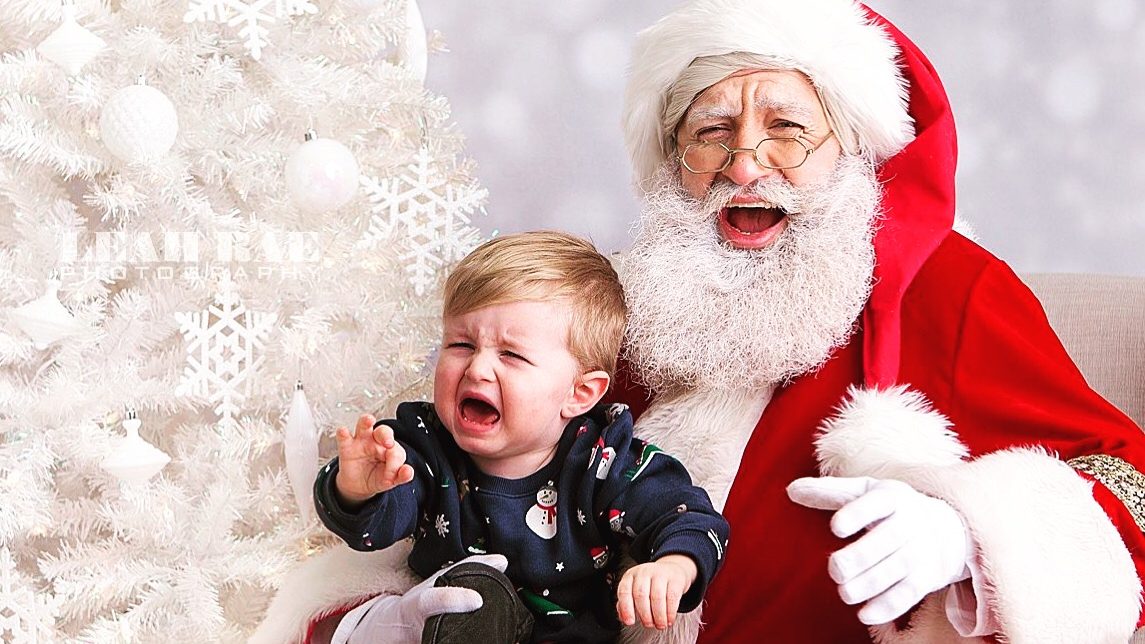
Have you ever seen those photos of crying kids sitting with Santa?

You know the ones I’m talking about, where the child is struggling to get away from Santa, reaching out for a parent with their arms and legs flailing, and looking absolutely terrified and miserable. Did you know that many parents find this funny?

I do not find these photos funny, not in the slightest. And not just because it’s terrible to have a miserable, terrified, flailing child sitting on my lap–it’s mainly because this is TRAUMATIC for the child. Unfortunately, many parents don’t seem to realize this, and think it’s a rite of passage to have a “crying with Santa” photo. It’s not. It’s traumatic for the child, and based on my graduate studies in counseling psychology, I reckon it may be detrimental to a child’s development, along with teaching them a VERY wrong lesson about consent.

Most often, the crying kids in these photos are between the ages of 18 months and 3 years of age, which aligns with Erickson’s psychosocial stages of development model. You see, from birth to about 18 months a child is developing a sense of trust vs. mistrust, and this is the most important period in a child’s development, it’s the foundation on which their perspective of the world is constructed. So when a child between 18 months and 3 years of age comes to see Santa around the holidays, they’ve got an understanding of who is in their trusted inner circle and who is a stranger–which is likely why children seem to develop a sense of “stranger danger” around 18 months. And while Santa seems like a kind and gentle character they may be familiar with, he’s not a part of their trusted inner circle, he’s a stranger. And by 18 months old a child has learned, hopefully, that it’s not okay to sit in a stranger’s lap.

After 12 years of portraying Santa Claus, I’ve had MANY parents force their child to sit with/on me despite their child being frightened and upset to be placed in the lap of a stranger without the child’s consent. Some parents even try to sneak place a child onto my lap without the child noticing what’s happening. In these cases, the child almost always freaks out when they turn their head and see my big white beard and red fur-trimmed suit, and I don’t blame the child for this in the slightest–but rather, attribute it to the parent’s lack of understanding of developmental stages. That’s why I’m sharing this message today, because sharing is caring. And like Dr. Seuss said, “Unless someone like you cares a whole lot, nothing’s going to get better, it’s not.”

This brings us to Erickson’s 2nd stage of psychosocial development, Autonomy vs. Shame and Doubt, which occurs from the age of 18 months to 3 years, and marks a time in a child’s life when they’re starting to gain independence and make some decisions about what they do and don’t like. And when parents allow their children to make choices and exercise some control, the child begins to develop a healthy sense of autonomy. But when a child is not allowed to exercise some control, they may doubt their own ability to make decisions and develop a sense of shame and helplessness.

This is the crux of my issue with the “crying with Santa” photo that so many parents mistakenly believe is either funny or a rite of passage. When a parent disregards a child’s ability to decide for themselves whether they feel comfortable and safe sitting with Santa, who is a stranger in a strange environment, the child is taught that 1) they don’t have control over their choices and preferences, and 2) they are not given the choice to consent or decline based on how this experience makes them feel.

My own children are 8 and 10 years old, and since before they could speak I have asked them if I can give them a hug or kiss them on the head, and as a result they have developed a strong sense of autonomy and boundaries regarding their bodies. We live in a time when there are very real concerns about consent and ensuring that all persons are given an opportunity to consent to what happens to them and their body.

I believe wholeheartedly that lessons about consent are ongoing rather than a one-time teaching, and this coming holiday season, if you’re planning to take your child to see Santa, I urge you to consider allowing your child to have the opportunity to consent to sitting with him, or not.

p.s. if your child does NOT want to sit with Santa, you can prepare for this by being ready to join the photo with your child. And sometimes, when a child and parent sit with Santa together for a few minutes, this provides an opportunity for transfer of attachment, and the child may feel comfortable sitting with Santa by themselves, so long as their parent stays close by.

Benefits of a Being a #HipsterSanta

I’m a young Santa. Maybe the youngest realbeard Santa in the world. And I love this gig.

There are a lot of benefits to being a young Santa. For one, I can still hop, skip, and jump around like a jolly old elf. Not all Santas are so lucky. I saw a Santa at the “dirt mall” in town who rolls into his North Pole on a Rascal scooter. Damn. During the Santa Claus parade in that mall, Santa had to re-route to the elevator because he couldn’t use the escalator–how magical is that? Shouldn’t a guy who’s able to travel around the whole world in one night be able to travel up and down an escalator? I think Santa should have magical characteristics, and shouldn’t have to take a break during his shift to check his blood sugar and re-wrap his gout affected legs. Gross. In my eyes, that’s a prime example of a Coca-Cola sponsored #DiabeticSanta. I prefer to think of myself as a #HipsterSanta sponsored by the Heart and Stroke Foundation.

Along with being a young Santa, I’m also a new father. I’ve got a 7 month old baby who is the most adorable kid in the entire world, in my unbiased opinion. So when parents bring an infant for a photo with Santa, and they seem nervous about putting their precious new child into the arms of a stranger, I tell them, “It’s actually a little known fact that Santa has a 7-month old baby at home in the North Pole.” This seems to put parents’ minds at ease. Added benefits of having a new baby at home are that I’ve learned many new ways to hold a baby, and have also gotten quite good at guessing kids’ ages–parents seem to appreciate this skill. Or they get a kick out it when I guess terribly wrong.

Last week my wife, daughter, and I were having a sick day. I’d brought home a nasty cough from my Santa gig at the mall. I suppose it’s to be expected after interacting with hundreds of germy kids every day, an occupational Santa hazard. I’ve decided there’s no point in getting vaccinations this year; I reckon I’ll be fully inoculated to most illness after exposure to thousands of kids this Christmas season. But anyway, with my wife, daughter, and I feeling ill, we had a movie day in the basement and watched Frozen. It’s the biggest kids movie of the year, and every single kid has seen it. I’ve since used my knowledge of Elsa, Anna, Kristoff, Olaf, and Sven to successfully ingratiate myself to kids. I simply mention that Olaf’s cousin lives at the North Pole with me, Mrs. Claus, and the Elves and kids are instantly more interested in listening to me. Or I tell ’em I’m planning to ask Elsa to build an ice workshop for me. I’ve found that shared familiarity breeds rapport and respect.

Each interaction I have with kids, I try to create what my shrink calls “extraordinary space.” There’s a sense of magic in the air that’s palpable as I connect with kids. I studied psychology in university and learned some counselling techniques, and I use these in every Santa encounter. The counselling technique I employ most often is an acronym, SOLAR. Here’s how it works: I Square up with the kid, adopt an Open posture, Lean in to listen, Aim my attention toward child, and maybe most importantly, Relax. This technique allows for a kid-centric Santa encounter in which the rest of the world seems to drop away and the child feels like the most special person in the world as Santa focuses his whole attention on the kid.

My mom came to a Christmas market where I was appearing as Santa. I imagine it was kind of a weird experience for her to see her thirty-three year old son in full Santa Claus regalia. Afterwards, she told me it was amazing to see how I focus closely on each kid, making them feel like they are the most important person in the world–I told her that in that moment, that is what they are to me.

Have I mentioned that I love this gig?

A Modern Santa: #BehindTheBeard

I want to update Santa for the modern era. Create a cool hipster Santa. Or maybe a hip-hop Santa. I don’t know precisely what I want the update to be, but it’s time for a 21st century reboot. One thing I am certain of is that Santa doesn’t have to be fat. Fuck that. I get comments from people sometimes about being a skinny Santa Claus. It’s usually guys making the comments, and they’re usually fatter than me wearing two fat-suits. I reckon the dudes making comments are just insecure and jealous of my fit not fat Santa body. I was wearing two fat-suits because people were skinny Santa shaming me, but I’m done with that now. Only one fat suit for this Santa. I’d rather my version of Santa be sponsored by the Heart & Stroke foundation than Coca-Cola.

Not your Grandma’s Santa Claus?

So here I am, writing, eating cookies and drinking milk, and becoming more like Santa Claus every minute. That’s me up there in the picture. Not the little Santa, the big Santa in the background. Santa ornaments can’t write a blog about becoming Santa Claus. Santa ornaments also can’t wonder why their life became so strange, and how amazing and absurd it is to become a thirty-three year old professional real-bearded Santa Claus.

If you’ve ever been walking through the mall and wondered how the guy portraying Santa became that guy, I’m gonna try to provide some insight. I want to share stories from my past, things that shaped me into the man I am today. The type of man that bleaches his hair and beard six times in as many weeks, wears glasses to look older, a fat-suit to look less fit, and more makeup than a drag queen.

That might be a bit irreverent for a Santa. But hey, I’m not your Grandma’s Santa Claus.

I’m a good Santa, a damn good Santa, I’d say. And others say the same. I’m a young Santa, a fit Santa, a juggling Santa. I’m a handsome Santa. I’m a philosophical storytelling Santa. As Santa I talk to kids about science being indistinguishable from magic, how an understanding of the big bang and quantum entanglement allows Santa to teleport into houses without chimneys, about the elves mischievous antics and Mrs. Claus’ delicious baking, and how all matter, even you and me, is merely energy condensed to a slow vibration. I like to mix the traditional with the contemporary, a synthesis of Christmas past and future, to make a Christmas present.

““““

I just finished my milk and cookies. And now I’m having a glass of wine. Can I tell you a secret? I used to hate Christmas. I was super-Grinchy. I’d get depressed around mid-November and it’d last till January. My old roommate, Tom, pointed out the cycle after living with me for a few years. Once he pointed out the seasonal cycle, I was better able to deal with it. Sometimes I succeeded in warding off depression. But not usually. Usually I lost the battle, the black dogs won.

Sometimes, when I was down,  I got real fucked up, like blackout loser drunk.  But usually I just got stoned. Really fucking stoned. My kitchen mentor, Mike Gerlach, nicknamed me THC because, he said, “there’s so much THC in your blood, a person could get high from smoking it.”

I started smoking pot daily when I was seventeen, about three weeks before Christmas, around the time my little brother died from a brain tumor. His death was also at the root of my seasonal depression cycle, I think. Another reason I smoked a lot of pot was ’cause I had a lot of pot, ’cause I sold a lot of pot. I was good at selling pot, even though I was always really stoned. Maybe because I was always really stoned. That indicated I truly believed in the product. And that it obviously worked quite well, judging by the ridiculous stoner talk I engaged in constantly, like wondering if an alley cat’s still called an alley cat if you take it out of the alley. And other profound and important philosophical gems.

Selling pot was Santa-like, in a sense. Santa receives orders for things boys and girls want and then he fills a sack with goodies and delivers the goodies from house to house. That’s exactly what I did when I sold pot. Except when I was feeling lazy, then I just had people stop by my apartment. And that happened a lot. That was more like kids going to the North Pole to pick up their presents from Santa, and then staying to hang out for a while and smoke a joint. It was a fun gig, while it lasted. I made it fourteen years without getting busted. But I was happy to leave it behind me. I couldn’t have a story of redemption if I was still a criminal. But that part of the story makes for a good prologue. Then, when this blog’s published, on the book jacket I can include comments like,

“Great read…the story of a man who’s gone from slangin’ dope to slangin’ hope.” –Jay Z

“What a journey, from patron saint of cannabis to patron saint of Christmas.” –Bill Hicks

“If I knew Santa knew where to get the good stuff, I would have asked for a bag of Purple Urkle for Christmas.” –Doug Benson